
The Warhammer Survivors wiki at https://warhammersurvivors-wiki.wiki/ is an independent fan reference covering champions, weapons, evolutions, enemies, stages, and bosses. It states that it is unaffiliated with Auroch Digital, Games Workshop, or poncle. Lexicanum's catalogue entry at https://catalogue.lexicanum.com/wiki/Warhammer_Survivors provides another encyclopedia reference for the game's identity and genre. Start with the fan wiki's gameplay categories for a specific topic, and use Steam's listing when checking the listed release date, minimum PC hardware requirements, or supported platform features.
Game identity, release listing, and creators
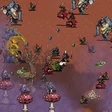
Warhammer Survivors is a standalone, single-player bullet-heaven roguelite, with champions, enemies, and weapons presented in animated pixel art. Lexicanum describes its action as a top-down roguelite horde shooter, offering another useful description of the same game's genre. For a newcomer browsing encyclopedia entries, these descriptions establish the basic format: surviving enemy hordes rather than simply identifying familiar Warhammer names.
Steam lists November 10, 2026 as the release date and credits Auroch Digital as both developer and publisher. The game is officially licensed and made in partnership with Warhammer and poncle, the company associated with Vampire Survivors. Keep that production relationship separate from the dedicated wiki's status, because a fan reference is not an official publication from those partners. The official description also identifies Auroch Digital with Warhammer 40,000: Boltgun, alongside its partnership credits for this game.
Champions and their starting equipment
The official feature list advertises over 40 playable characters drawn from Warhammer 40,000 and Warhammer Age of Sigmar. Malum Caedo, from Warhammer 40,000: Boltgun, is explicitly included among the named examples. The roster therefore brings characters from both settings into this game, making each character's universe a useful detail to check when browsing champion entries.
Sebastian Yarrick and Neave Blacktalon are also named playable characters in the official description. Yarrick is introduced as a legendary Commissar, while Blacktalon is described as a lightning-forged Stormcast Eternal. The champions differ in their starting stats as well as their starting weapons, which you can compare when deciding whom to play.
Weapons, evolutions, passives, and power-ups
The advertised arsenal contains 75+ weapons. Named examples include the Boltgun, Astartes Chainsword, and Whirlwind Axes. The pot of Nuln Oil also appears in the weapon list, where it is explicitly described as an easter egg. The official description presents evolved weapon forms through their effects: screen-clearing storms made up of bullets, blades, and magic.
Weapons can be mixed with power-ups and evolved into new forms, making evolutions a separate topic worth checking alongside the original weapon. The official feature list also includes passives and power-ups that help champions endure enemy legions. For a particular equipment question, distinguish the weapon, any associated power-up, and the evolved form rather than assuming that a weapon's name explains the entire combination. The dedicated fan wiki lists both weapons and evolutions among its coverage categories, giving you relevant places to begin that lookup.
Stages, enemy factions, and major bosses
Multiple modes and stages span the 41st Millennium and the Mortal Realms. Named battlefield examples include the open, ashen plains of Aqshy and the confined corridors of an abandoned Space Hulk. Those descriptions give you concrete settings to look up, with an open landscape and a corridor-based environment represented in the game's advertised battlefields. The official description frames that choice as becoming a legend of the Imperium or a champion of Order.
Each stage has its own enemy faction, according to the official description. Named enemies include Skaven and their warpstone-addled abominations, as well as Tyranid swarms and monstrous Xenos bioforms. The stage description also promises secrets to uncover in each arena.
Surviving long enough brings encounters with huge, screen-filling bosses, including Ghazghkull Thraka and Vizzik Skour, Prophet of the Horned Rat. The official feature list also names the Great Unclean One among the monsters players can face. Extremis Bosses are highlighted as a challenge even for experienced survivors-like players, making that term useful to recognize when browsing boss information.
Gold, paint pots, and discoveries
During runs, players collect gold while trying to survive waves of enemies. The gold you collect helps you grow more powerful in future runs. When reading about progression, distinguish this future-run benefit from a champion's starting stats and from weapon evolutions, since the descriptions identify different parts of the game.
Warhammer paint pots found on the battlefield unlock new character forms and secrets. The feature list separately advertises secrets and collectables, while stage descriptions also mention discoveries tied to their arenas. For a question about a character form, begin with the paint-pot connection; for an arena discovery, begin with the relevant stage. This keeps your search focused on the kind of discovery you want to understand without treating every collectable as the same progression item.
Demo, Steam Deck, controls, and accessibility
The Steam listing offers a Warhammer Survivors demo and marks Steam Deck compatibility as Verified. It also advertises full controller support for Xbox and PlayStation controllers. These are useful store details to consult before choosing how to try or control the game, alongside the separate gameplay entries in a fan encyclopedia.
Steam lists Camera Comfort among the game's visual accessibility options. The audio options listed are Custom Volume Controls and Stereo Sound. The input-related entries include a Keyboard Only Option, Playable without Quick Time Events, and Playable at Your Own Pace.
Interface languages and minimum PC requirements
Steam lists interface support for English, French, Italian, German, Spanish from Spain, Japanese, and Korean. The table also includes Polish, Brazilian Portuguese, Russian, Simplified Chinese, Turkish, and Ukrainian. It does not mark full audio or subtitles for those languages, so read the interface column specifically when checking language support. This distinction matters when choosing a language: the listed interface support does not itself establish matching voice or subtitle coverage.
The listed minimum PC requirements specify Windows 10 Home 64-Bit, a Dual Core 2.4 GHz x86-64 processor, and 4 GB RAM. For graphics, the minimum is a GTX 750 or an equivalent graphics card, with 5 GB of available storage required. Compare each listed component with your own system when checking the requirements, keeping the graphics equivalence wording in mind. Treat this as the minimum specification list rather than a promise of a particular frame rate, resolution, or graphics setting.